|
| Author |
Message |
jcmcnabb
Member
|
# Posted: 3 Dec 2025 11:43pm
Reply
Hi all,
We're building a 24 x 28 arched cabin (kit from arched cabins llc) in southern Arizona. Hired a backhoe to dig trenches for our piers (pr-cast stackable EZ-Tubes, 3 rows of 5) and he dug them slightly out of parallel. We will be putting short 6x6 posts on the piers to support double 2x12 beams.
I'm trying to figure out the best way to get the beams as parallel as possible, with the outer beams being about 8" out of parallel (north side about 8" closer than the south).
I have very little wiggle room with the post bases on the piers, so the best solution I've come up with is to notch the outer side of the north posts to separate the beams and notch the inside of the south posts to bring them closer. The intermediate posts would have basic Simpson brackets.
This gets me much closer to parallel, but I want to make sure I'm not missing anything (e.g. is there something wrong with notching opposite sides of posts).
Thanks!
|
|
Grizzlyman
Member
|
# Posted: 4 Dec 2025 05:08am
Reply
Man that sucks!
Generally you’ve got the depth of the joist that you can cantilever the joists over the beam. So if it’s 2x 10 joists you can cantilever ~10” over the beam. The beams doen’t have to be perfectly perpendicular at the end of the day.
Is you 8” too wide or too skinny for the dimensions of your build? If it’s too wide, then you could just have very little cantilever on the wide side and a larger but still appropriate cantilever on the skinnier side.
If it’s too skinny then I’m not sure what you could really do other than adjusting your build dimensions.
As long as your joists are square you’d be fine.
I’m not sure about notching opposite side of the post… whether that would cause some rotational force or not.
…My .02
|
|
jcmcnabb
Member
|
# Posted: 4 Dec 2025 05:20am
Reply
I appreciate the $0.02!
You raise a very important fact that I omitted, which is that I have designed the subfloor to overhang the beams on the East and West sides. So I can make the subfloor square without issue! My concern is mostly about uneven weight distribution on the beams due to the uneven overhang from them being non-parallel.
The opposed notching method get's me from 8" difference to about 2" difference.
I think you are right that it probably doesn't make a big difference, especially with a relatively light weight structure.
|
|
Brettny
Member
|
# Posted: 4 Dec 2025 10:29am
Reply
The girders not being parallel should matter if the design allowed for floor joists to overhang. You can mix match what side of the 6x6 post you notch out and that will help some.
I think the bigger issue you may have is how your going to brace those 6x6 posts. We ended up pouring the concrete right up to the bottom of the girder.
|
|
gcrank1
Moderator
|
# Posted: 4 Dec 2025 10:31am
Reply
I question the 'short posts' on top of nice piers. My guess it you are intending to use the posts to level the tops but aren't they going to be a weak link with all that substantial building weight on 'em?
|
|
jcmcnabb
Member
|
# Posted: 4 Dec 2025 12:45pm
Reply
Brettny - I would have loved to pour piers up to the girders but not possible (or just a huge PITA) where we are. The stackable piers are great, but extremely challenging to level and they aren't made to stack much above grade.
The posts will be about 18 - 24" tall with lots of knee bracing. Shorter posts are sturdier than taller posts, though the bracing won't be as robust.
gcrank1 - You are correct that the posts are mostly for leveling (as stated above). They will be the "weak link", but if the weak link is still more than adequate, then we should be ok 
I can make the posts taller to accommodate better bracing, but again, it's a trade off as shorter posts impart far less moment force than taller ones, this requiring less bracing.
|
|
MtnDon
Member
|
# Posted: 4 Dec 2025 12:55pm - Edited by: MtnDon
Reply
Quoting: jcmcnabb short 6x6 posts on the piers
That basically creates two points at each pier that can act like hinges. Not a good plan. Beams would be much better resting directly on the piers.
Think of big winds or seismic events. Let's say the wind is blowing against a wall. The building wants to go sideways. The top and the bottom of the wood post is nailed to the brackets. The posts will want to rotate (top & bottom act like a hinge).
The normal base connectors are designed to resist upload forces and lateral forces. By lateral, they mean sliding forces at the connector bracket. There are special bases known as Moment Post Bases. $$$!!! In engineering talk, a moment force is a rotational force around the base connection. Like a hinge.
|
|
jcmcnabb
Member
|
# Posted: 4 Dec 2025 01:54pm
Reply
MtnDon - your theory is sound, but many cabins are built this way. Most use taller posts than mine, which impart far higher moment forces than shorter posts. Granted, taller posts allow for better bracing (more space) to resist those forces.
The bending moment is proportional to the lateral force at the top of the post x the height of the post. So a 4ft tall post will impart double the moment force at the post base compared to a 2ft tall post.
|
|
|
FishHog
Member
|
# Posted: 4 Dec 2025 02:06pm
Reply
Quoting: jcmcnabb MtnDon - your theory is sound, but many cabins are built this way.
Just because many do it, doesn't make it a smart way to do it. I wouldn't, despite what my neighbors might have done.
|
|
jcmcnabb
Member
|
# Posted: 4 Dec 2025 02:16pm
Reply
FishHog - I chose this method because it was the most feasible for us. Is it the best way? Perhaps not. The fact that many cabins are built this way and still standing is useful information in my decision making.
Sometimes the best way isn't possible.
|
|
Brettny
Member
|
# Posted: 4 Dec 2025 02:43pm
Reply
Have a picture of the stacked piers? 18in tall 6x6 posts are going to be prety hard to support from racking. Also dont put your floor joists so low you cant get under the cabin.
I sat next to my middle sono tube and cut it off at my head height. I can sit under most of it. Between plumbing, electrical and Insulation I have alreaty spent far to much time under there but glad i could sit up.
|
|
DRP
Member
|
# Posted: 4 Dec 2025 02:54pm
Reply
https://icc-es.org/report-listing/esr-5035/
|
|
jcmcnabb
Member
|
# Posted: 4 Dec 2025 02:57pm
Reply
Brettny
Sure! Here is a photo of the piers as they were going into the ground. Not much different now other than that they are all backfilled.
The minimum here for the joists is 18" above grade, but you make a very good point about leaving room down there to maneuver / build. As you can tell, it's a dry climate...
The shorter posts definitely leave little room for bracing, but again, they are more resistant to racking than taller posts to begin with (think walking in high heels vs boots). It might be worth it to have longer posts for the maneuverability, but also just so I can add substantial bracing for peace of mind.
Thanks
|
|
rpe
Member
|
# Posted: 4 Dec 2025 03:37pm
Reply
Why not pour a sonotube extension on top of each pier? You could get perfect height, and embed a saddle for directly fastening the beam at the same time. Saddles could be offset to help compensate for the pier misalignment at the same time. I'd feel better about that type of solution compared to a stubby 6x6.
|
|
FishHog
Member
|
# Posted: 4 Dec 2025 04:14pm
Reply
Good idea RPE.
And I understand that "the best way isn't always possible", but I've had to redo stuff enough over the years that I've learned striving for the best way when your younger and capable is better than having to redo or fix stuff as you get older.
|
|
jcmcnabb
Member
|
# Posted: 4 Dec 2025 06:25pm
Reply
rpe
That's a very interesting idea.
Are you suggesting that the sonotube would be wider than the ez-tube, such that it forms a collar around top of the ez-tube and extends above? I like it...
FishHog
I hear ya. I've had to rebuild mistakes as well.
|
|
rpe
Member
|
# Posted: 4 Dec 2025 07:02pm - Edited by: rpe
Reply
Quoting: jcmcnabb Are you suggesting that the sonotube would be wider than the ez-tube, such that it forms a collar around top of the ez-tube and extends above? I like it...
If you can find a sonotube that's a snug fit, I'd go that route. I built my piers by stacking bull-nosed blocks. To get the final height correct, I cut some with a masonry saw. Two others needed only a couple inches, so I tried a couple different methods - wrapping shingles around one pier, and framing with 2-by lumber for the other. Both worked well, allowing some up/down adjustment checked by laser prior to filling with concrete. I've attached a couple pictures. You can see in the final pictures that I only added a couple inches using the above methods, but with appropriate forming you should be able to do something similar for your application.
I'm jealous of your dry conditions. Check out the water in that pier hole. That combined with clay and frigid winters makes frost heave issues a challenge you won't need to deal with!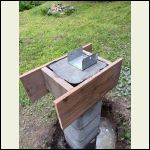
Wood-framed pier form
| 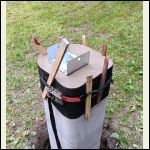
Shingle pier form
| 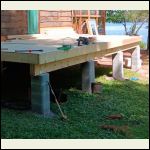
Beam and floor
|  |
|
|
Brettny
Member
|
# Posted: 5 Dec 2025 08:19am
Reply
Is that threaded rod up though each stacked block? Can you weld? Can you mix concrete on site?
I would get a sono tube bigger than the OD of what's there. Split it and clamp it around the current one and cut to the height of the bottom of your girder.
Bracing isnt going to work well with those type of loose stacked blocks with a single rebar/threaded rod in the middle. How do they expect you to attach to the top of that?
|
|
|

