| . 1 . 2 . >> |
| Author |
Message |
philpom
Member
|
# Posted: 12 Jan 2026 05:35pm
Reply
When our cabin originally went up the floor had batting insulation put under the floor and was sealed underneath with vapor barrier that wrapped up and around the girders and was nailed in. Nice and tidy, clean look but now almost 15 years later the vapor barrier has weathered and a combination of wind and critters has started to pull it down and get at the insulation. Some of it has been displaced making for some cold spots on the floor.
I first thought to prevent this again is 1 of 2 things.
new batting insulation where needed and close it off between the girders with 1/4" plywood.
or
Replace the batting where it is missing and close it off between the girders with rigid foam board, think Corning, and possibly sealing it in place with great stuff.
Thoughts? Other ideas? There is some plumbing that comes through the floor with plans to add some additional plumbing so I don't want to make that a royal pain. For the most part there is plenty of working room under the cabin, can stand under much of it but it gets a little tight on one end, down to about 12".
Thanks y'all.
|
|
spencerin
Member
|
# Posted: 13 Jan 2026 10:58pm
Reply
For the sake of uniformity, I'd replace the fiberglass with fiberglass and seal the *entire* underside with the plywood.
|
|
Brettny
Member
|
# Posted: 14 Jan 2026 03:24pm
Reply
I did 4in polyiso under my floor. I ran all my pex above the insulation and sealed it all with cans of foam. Then I used 1/4 plywood to cap the bottom of the floor joists. Leaves a pretty smooth bottom so cridders cant get in. We have no skirting and dont plan to.
Yes it sucked to install but it's a very warm floor. Warmer than our full time house with basement.
All my drain plumbing is going directly down with insulation and heat trace. All we have at the moment is a sink drain to a french drain. Hasnt froze yet and havent needed to use my heat trace.
|
|
philpom
Member
|
# Posted: 14 Jan 2026 06:41pm
Reply
Quoting: spencerin For the sake of uniformity, I'd replace the fiberglass with fiberglass and seal the *entire* underside with the plywood.
Thanks for the reply, that was my initial thought, think that is what I'll do and seal it with great stuff. It'll be most durable that way.
|
|
philpom
Member
|
# Posted: 14 Jan 2026 06:59pm
Reply
Quoting: Brettny I did 4in polyiso under my floor. I ran all my pex above the insulation and sealed it all with cans of foam. Then I used 1/4 plywood to cap the bottom of the floor joists. Leaves a pretty smooth bottom so cridders cant get in. We have no skirting and dont plan to.
Thanks for the reply. Hindsight tells me doing this or even just 4" Corning rigid foam board + plywood would have been the best original plan but since 90% of the batting is still in good shape I'll end up replacing what has fallen and then sealing with plywood.
Our shower drain comes through the floor and sooner than later the indoor kitchen and outdoor kitchen sinks will but they will tie together before penetrating the floor and are only about 8 feet from the shower drain. They will all tie together below the insulation. Being drains only I don't think there is a big concern about freeze protection (am I wrong?). The inside kitchen is against the wall shared with the screened in porch where the outdoor kitchen is. All of the fresh water plumbing will eventually be inside cabinet counters on that wall on the porch side and heated as needed (like one does a pump house) but easily accessible for inspection/repair. Thoughts on that plan? That general location is where the instant hot water heater is so tying all that together will be easy. Also, the propane will be shared between the water heater, stove and oven that all lives on that porch. 4' walls on the ends of the screened porch and 2' wall along the back. It's about 10' off the ground looking out over the forest and down the ridge side - dramatic in a good thunderstorm 
|
|
Brettny
Member
|
# Posted: 15 Jan 2026 10:23am
Reply
P traps can freeze. If your putting them under the sub floor I would make an acess pannel in your plywood covering. This is what I plan on doing for shower and toilet.
I'm not sure if the vertical section has much chance to freeze for a drain pipe but a few bucks in foam and a $18 heat tape is prety cheap not to put on. I ran the heat tape on my drywell alltheway to the underground basin.
|
|
jsahara24
Member
|
# Posted: 15 Jan 2026 11:32am
Reply
Our shower drain goes under our cabin and below the insulation. It definitely freezes once temps get into the teens. The horizontal/vertical runs do not have this issue.
We added heat tape on the trap and that clears it up in an hour or two if it freezes up on us.
|
|
philpom
Member
|
# Posted: 15 Jan 2026 01:26pm
Reply
Sold, heat tape and insulation on all plumbing on the porch and the main cabin trap underneath seems like a golden insurance plan.
|
|
|
gcrank1
Moderator
|
# Posted: 15 Jan 2026 02:21pm
Reply
If all you are running out is shower or sink (no sewage) to a French drain or dry well set up is a P Trap even needed. My impression is they are to stop gas from incoming back up from a septic tank.
No trap, no freeze up.
|
|
Brettny
Member
|
# Posted: 15 Jan 2026 03:19pm
Reply
Smells from a drain would be my issue with no P trap. I changed my under sink P trap to a waterless trap last trip. One less thing to winterize before we leave each winter trip.
|
|
philpom
Member
|
# Posted: 15 Jan 2026 08:20pm
Reply
I pondered if a trap was really needed since it is just shower and soon sink but I figured it was best practice. Also, I don't want wasps to suddenly start coming up through the drains some day! Some RV anti-freeze in the trap for winter when we aren't there would work to prevent damage.
|
|
rpe
Member
|
# Posted: 19 Jan 2026 02:51pm
Reply
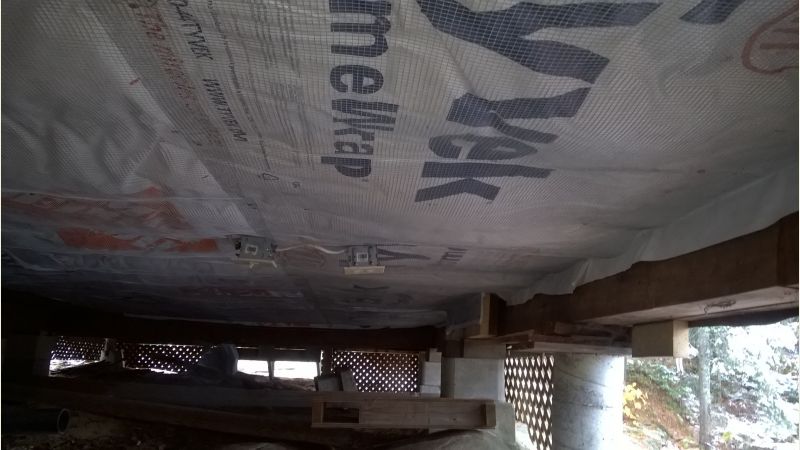
I used Rockwool between the floor joists, Tyvek stapled under to hold it snug, and 1/4" galvanized hardware cloth to keep the critters out. 8 years and no issues thus far.
I've had great luck with these water p-traps. They are commonly used in RV applications in north america, but approved for residential in Europe. We've had them installed in sinks and shower, and have had no issues. One less item on the winter departure check-list.
|
|
rpe
Member
|
# Posted: 19 Jan 2026 02:55pm
Reply
We still use the rv-antifreeze in the toilet, but I really don't like the odour. It's not particularly strong, but I find it off-putting for some reason. I suppose I should crawl underneath, disconnect, and cap the toilet drain for winter season. Then clear the trap and leave the toilet dry? For some reason I'm only thinking of this now while typing it. Somebody remind me next fall!
|
|
gcrank1
Moderator
|
# Posted: 19 Jan 2026 06:33pm
Reply
Wonder if you could use bourbon?
|
|
rpe
Member
|
# Posted: 19 Jan 2026 10:58pm
Reply
Quoting: gcrank1 Wonder if you could use bourbon?
Sounds like a fire hazard!
|
|
DRP
Member
|
# Posted: 20 Jan 2026 06:49am
Reply
They passed me in chemistry so I wouldn't come back, but, I believe glycols are alcohols, only bad bourbon! I've heard old timers talk about having to substitute one for the other in cars during rations.
|
|
philpom
Member
|
# Posted: 20 Jan 2026 09:23pm
Reply
Quoting: rpe We still use the rv-antifreeze in the toilet, but I really don't like the odour. It's not particularly strong, but I find it off-putting for some reason. I suppose I should crawl underneath, disconnect, and cap the toilet drain for winter season. Then clear the trap and leave the toilet dry?
Draining and capping would work but a pain. I operate a recreation club that has "outdoor" restrooms, we use the RV fluid in those toilets and sink p-traps. You might be able to use wiper fluid like what you use for the car or truck. It's antifreeze and at least the kind I use smells fresh.
|
|
MtnDon
Member
|
# Posted: 20 Jan 2026 09:34pm
Reply
Quoting: philpom You might be able to use wiper fluid like what you use for the car or truck
The anti-freeze component is methanol or ethanol. Is it not likely that the alcohol will evaporate and at some point allow the water that left to freeze?
|
|
philpom
Member
|
# Posted: 20 Jan 2026 09:45pm - Edited by: philpom
Reply
Quoting: MtnDon The anti-freeze component is methanol or ethanol. Is it not likely that the alcohol will evaporate and at some point allow the water that left to freeze?
That's why I said might and you are right, it probably would. Not certain but I suppose that would take bourbon off the list, even cheap bourbon.
A little research tells me that wiper fluid will work in a pinch for a shorter term solution, it is used this way when folks are in a pickle but for long durations it can evaporate. It's also toxic so never use it in fresh water systems.
Good catch deserving of clarification.
|
|
rpe
Member
|
# Posted: 21 Jan 2026 09:37am
Reply
I'd be worried about wiper fluid killing off the good bacteria in the septic system. Perhaps I should just add some potpourri to the bowl!
|
|
Brettny
Member
|
# Posted: 21 Jan 2026 10:10am
Reply
Waterless traps can be had for as little as $15. RV antifreeze is aboit $4gal so within a few gallons and the trap has alreaty paid for its self. Not to mention no maintenance and it will never freeze if forgotten about.
|
|
DRP
Member
|
# Posted: 21 Jan 2026 10:55am - Edited by: DRP
Reply
I always wondered about that when we went on the road, I would use about a half gallon of regular anti freeze in the house traps. I suspect the tank died in our extended absences anyway and then the first flush was poison... but 35 years later it still works. When I was a kid the excavator would throw road kill in a new tank claiming it would help get it going... hillbilly probiotics I guess. I think we "donate" all it needs.
One other term I've heard used for glycols is "permanent water" they evaporate very slowly. That is why they are in borate products for dry wood, the water evaporates pretty quickly but the glycol maintains a wet edge allowing much deeper penetration.
Epic storm coming, save the whiskey!
|
|
philpom
Member
|
# Posted: 21 Feb 2026 02:06pm
Reply
Got up there just after the big snow storm in ja uary and took a good look underneath the cabin. Kinda worse than I thought but on the other hand there is no clean out required before I repair it.
|
|
philpom
Member
|
# Posted: 21 Feb 2026 02:09pm
Reply
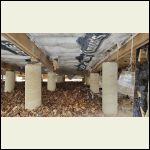
All other sections are in reasonable shape like pic 2. I wonder where the insulation went from the one secrion....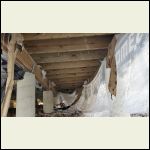
20260131_150724.jpg
| 
20260131_150702.jpg
|  | |
|
|
Brettny
Member
|
# Posted: 22 Feb 2026 07:03am
Reply
Looks like animals have been living in every bit of that insulation. I would pull it all down. Replace it and cover it with plywood. If it was covered in plywood to begin with it would have been fine.
|
|
rpe
Member
|
# Posted: 22 Feb 2026 07:58am - Edited by: rpe
Reply
I think I can see where the cold spots in your floor might be!
Rather than plywood I used 1/4" hardware cloth nailed to the underside with roofing nails. Coming up on 10 years now, and there have been no issues.
We have lots of red squirrels (tree rats) and they chew through almost anything. Plywood might not be enough.
|
|
gcrank1
Moderator
|
# Posted: 22 Feb 2026 11:35pm
Reply
My guess is you have critter tunnels and nests all through that.
Btdt.....in our whole building, had to tear it down and start over. Ours was a real mouse and tree rat (little red squirrel) hotel 
|
|
philpom
Member
|
# Posted: 23 Feb 2026 06:40pm - Edited by: philpom
Reply
Quoting: Brettny Looks like animals have been living in every bit of that insulation. I would pull it all down. Replace it and cover it with plywood. If it was covered in plywood to begin with it would have been fine.
Foresight is great but in this case hindsight and rework will have to do. It happens like this some times.
|
|
philpom
Member
|
# Posted: 23 Feb 2026 06:44pm - Edited by: philpom
Reply
Quoting: rpe I think I can see where the cold spots in your floor might be! Rather than plywood I used 1/4" hardware cloth nailed to the underside with roofing nails. Coming up on 10 years now, and there have been no issues. We have lots of red squirrels (tree rats) and they chew through almost anything. Plywood might not be enough.
That section missing all of the insulation is below the bathroom/shower. That's what prompted me to take a good look!
That looks nice, did you by chance prepare a price comparison between say 1/4" ply and the hardware cloth? It would also be more forgiving from an installation standpoint.
|
|
Brettny
Member
|
# Posted: 24 Feb 2026 08:37am
Reply
Take the sqft needed and calculate each materials sqft. Simple calculation. If you want to get more fancy with it calculate the amount needed to span in full sheets of each.
|
|
| . 1 . 2 . >> |

