|
| Author |
Message |
tedtedted
Member
|
# Posted: 18 May 2026 03:16pm
Reply
Hi folks! I recently broke ground on my first real construction project, a small off-grid cabin located in the foothills of the cascade mountains in WA.
The cabin is small enough that it does not need to be permitted (12 x 16), but I am trying to gain experience in doing things the right way, so I'm attempting to follow code when possible and doing some back-of-napkin engineering where not possible.
I'll share more soon about the plans for the structure, but I've got some foundation questions to start with.
Unfortunately the foundation is an area where I'm not able to meet code, due to access and cost limitations. Modern code requires continuous footings, but I'm building in the 100-year flood zone, so I want to elevate the structure by 2-3 feet above grade. I'm over an hour away from the closest concrete batch plant, and the road to access the site is too tight for a concrete truck to make it in regardless. So I've decided to use over-sized concrete footings dug into the ground, and piers to bring the foundation up to girders.
I'm using two rows of 3 piers, 6 total. The corner footers are 24x24x6", and the center footers are 30x30x7". The piers are 10" sonotubes.
https://i.imgur.com/GyD6nrC.png
Over the previous few weekends I dug out footers to below the frost line and placed ~4" of 3/8" minus gravel and tamped it down.
This weekend I cut and tied rebar, and poured the footings. (concrete on this pour is a little wet, I did better on the others).
https://imgur.com/a/LBXN5nj
Now my plan has been to use sonotubes to bring the foundation all the way up to the horizontal girders, but after wheeling the mixer around yesterday I'm realizing that getting the concrete into the tubes ~3 feet off the ground is going to be a serious challenge.
Can anyone recommend a method for accomplishing this? some kind of movable plywood ramp or platform? A stand of some sort for the mixer?
Should I just give up on the tall concrete piers and use PT 6x6s for the verticals?
Thanks,
Ted
|
|
jsahara24
Member
|
# Posted: 18 May 2026 04:41pm - Edited by: jsahara24
Reply
I think concrete piers is a better end product if you can figure out how to get it done.
You could also do some type of masonry block pier poured solid which could limit the amount of concrete needed?
|
|
tedtedted
Member
|
# Posted: 18 May 2026 05:11pm
Reply
I was just thinking about the block possibility. I might have screwed myself on that with the way I placed the vertical rebar for the tubes, though.
|
|
gcrank1
Moderator
|
# Posted: 18 May 2026 05:21pm
Reply
A small, say mini tractor with a front end loader to mix or pour the 'crete in, elevate to working dump hight and shovel into the top of the tubes.
|
|
MtnDon
Member
|
# Posted: 18 May 2026 05:29pm - Edited by: MtnDon
Reply
I am curious if the "no permit required" that you mentioned, is based on the 200 sq ft rule that usually applies only to accessory buildings, like sheds and playhouses, or the special 400 square feet or less rule that applies in rural zones or unincorporated counties that have specifically adopted that?
|
|
tedtedted
Member
|
# Posted: 18 May 2026 06:01pm
Reply
Quoting: gcrank1 A small, say mini tractor with a front end loader to mix or pour the 'crete in, elevate to working dump hight and shovel into the top of the tubes.
That does sound like a good option. I'm trying to get away without renting equipment, but this might be worth it.
Quoting: MtnDon I am curious if the "no permit required" that you mentioned, is based on the 200 sq ft rule that usually applies only to accessory buildings, like sheds and playhouses, or the special 400 square feet or less rule that applies in rural zones or unincorporated counties that have specifically adopted that? Also, for a 12 x 16 three rows of piers seems excessive. A 12 foot width can be done with two rows and saves labor.
I'm applying the county's 200sqft accessory structure rule. No sleeping allowed, of course ;). And yes, 2 rows of 3 piers. 12ft span max.
|
|
rpe
Member
|
# Posted: 18 May 2026 07:36pm - Edited by: rpe
Reply
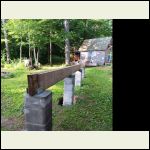
Locally many remote cabins and cottages are built on piers. 12"x12" pier blocks are readily available for this purpose. For installation, I use the same method you describe for the footer, then thread pier blocks over the rebar, and fill with concrete mix as I go. The end result is a 12x12 square pier with embedded rebar - very solid.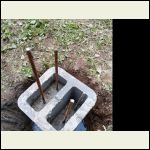
20250601_081340a.jpg
| 
20250623_081453a.jpg
|  | |
|
|
rpe
Member
|
# Posted: 18 May 2026 07:55pm
Reply
Cont'd from previous:
Some use mortar between the blocks, which means you're mixing a small batch of mortar along with the concrete mix. Others will 'dry-stack' the pier blocks and just fill with concrete mix. Either way is probably OK but the mortared joints look better and make it easier to adjust for level as you stack and fill. Vibrating or other method of working the concrete mix into the pier cavities is important to ensure no voids, which could potentially retain moisture and crack in freezing conditions.
|
|
|
DRP
Member
|
# Posted: 18 May 2026 08:27pm
Reply
That shallow, you're down here somewhere.
The prescriptive call for a continuous footing with continuous perimeter foundation walls topped by a well connected floor diaphragm is to provide resistance to lateral loads. Whatever way a horizontal, wind, load hits the building, the floor will send the lateral load down the appropriate long walls which will not overturn. If the floor sends that load to individual piers there needs to be something to keep them from overturning. When you step outside of prescriptive code, you enter the engineering path.
The pier embedment depth is too shallow to provide any lateral restraint. You lost the easy ways of bracing walls or deeply buried soil braced piers. Provide lateral bracing in both directions somehow... engineering says quantify load and provide resistance. The replies above were not to code and no one did any napkin engineering.
I'm looking at RPE's last pic and unfolding a napkin, let's think through it. There are 3 piers in a line so the perpendicular face is the 12' side at this end. Napkin... call that end 150 sf. Call the wind load 20psf. There's 3000 lbs pushing on that end, 2 rows of piers, the row in the pic has 1500lbs pushing on the end of that girder on top of a pier sticking 3' out of the ground with no other bracing. Are you comfortable with that? I can tell you no engineer working in his area of expertise would be. Look at it from the other direction, lots more sail and 2 piers in the row resisting a higher force... you're backin up.
There are ways to brace that... but why bother, its a thinking problem.
Post frame it, the sheathed walls brace the posts. The math is beam overhanging support, code referenced stuff.
What MD was hinting at, there is no size exemption for a habitable building. This confuses a lot of people. The exemption is for an accessory structure. An outbuilding, that is specifically defined, that is accessory to the habitable structure on that property.
|
|
tedtedted
Member
|
# Posted: 19 May 2026 07:04pm - Edited by: tedtedted
Reply
Quoting: DRP The prescriptive call for a continuous footing with continuous perimeter foundation walls topped by a well connected floor diaphragm is to provide resistance to lateral loads. Whatever way a horizontal, wind, load hits the building, the floor will send the lateral load down the appropriate long walls which will not overturn. If the floor sends that load to individual piers there needs to be something to keep them from overturning. When you step outside of prescriptive code, you enter the engineering path. The pier embedment depth is too shallow to provide any lateral restraint. You lost the easy ways of bracing walls or deeply buried soil braced piers. Provide lateral bracing in both directions somehow... engineering says quantify load and provide resistance. The replies above were not to code and no one did any napkin engineering.
Thanks for the critique DRP. I actually have been calculating the overturning forces on the structure as a whole, but I hadn't thought hard enough about the lateral forces against the piers.
I _am_ interested in thinking about the best ways to brace the piers while balancing other requirements. The whole point of this project for me is to learn a few skills and make mistakes on a low-stakes build, so that I can be in a better position to design and build a proper livable cabin on the property in the coming years.
So with that in mind, here are the options I'm considering for bracing:
1. Keep concrete piers low, build up with PT 6x6s and lateral bracing. Easy to keep the piers from toppling, but more concern about longevity of the wood.
2. Add grade beams to connect the footers together. More digging and rebar work, but doable.
3. Keep concrete piers but add PT knee bracing. Needs more hardware, but much easier to replace the bracing if it rots than a load bearing post.
4. Keep concrete piers but add wire rope X-bracing.
Let me know what you think.
|
|
rpe
Member
|
# Posted: 19 May 2026 07:07pm
Reply
DRP brings up excellent points about lateral loading. I was commenting about construction methods only, not endorsing the overall design. The piers shown in my picture support a 240 sq ft addition to the main cottage, which itself rests on a mix of piers and exposed bedrock. Piers are built on footings that are pinned to bedrock.
|
|
DRP
Member
|
# Posted: 19 May 2026 08:50pm
Reply
Very often people see some piers on a build and think the whole structure can be on piers, well, maybe. But often the main building is the "anchor" and the pier portion is picking up its lateral stability from the anchor structure. There's many ways to the top. I'm not saying my notions are the only way.
Ted, you offered me several options for trying to brace the pier by grabbing it with little or no mechanical advantage. I showed a way that gives quite a bit of mechanical advantage in bracing, why are you dismissing it?
|
|
tedtedted
Member
|
# Posted: 20 May 2026 12:00am - Edited by: tedtedted
Reply
I hear you, lack of knowledge is certainly part of my challenge here. But don't forget that I'm also cheap and lazy 
Seriously though, I did consider other foundation types... due to the flood zone I needed to build up, and pricing out a stem wall to the required height quickly ran out my budget. Helical piers were appealing but also quoted over $5k.
OK, so, post framing. This does have some big advantages in lateral stability, as you said the mechanical advantage is massive.
One reason I'm weary of post framing is that I would like to keep my load bearing wood members at least 1 foot above grade. I might be convinced that this isn't necessary with pressure treated lumber, but I've heard a lot of horror stories here.
The other (and main) reason is that I'm not as confident that I can get the structure dried in in one summer. I'm working mostly by myself, and mostly just on weekends. I am hoping to have a fairly high ceiling and additionally a standing height loft, so the posts would have to be almost 20 feet tall. I don't have access to machinery or even really a way to haul a rented telehandler or whatever would be the best tool here. But I do feel confident that I can nail together some stick framed walls and get some folks out to help me stand them up.
Looking at the MWFRS Wind calculations for my exposure and conservative (tall) prospective elevations gives me ~5227 lb of wind base shear to resist.
Post framing gives very strong bracing to the posts themselves, but they still need to be connected to the footers. If we bring the posts down to the footers and pour around them, the eccentricity is minimal and footer moment is only 452 ft-lb, no problem there. But wet setting the post in concrete raises lifespan concerns, especially in the floodplain here.
If I place the post base on top of a pier 2 inches above grade, this increases the footer moment up to 1475 ft-lb. Which by my back of napkin calculations, means we still would be risking overturning on the piers unless we use a fancy moment base ($300 / pier).
I did these calculations for 4x4 knee bracing and this similarly needs a moment base to avoid tip-over.
Cable X-bracing is more promising here... the cable tension works out to 1700 lb (5/16 cable would be OK) and would neatly handle lateral loads to prevent toppling. No wood under the base flood elevation. I need to do some more reading to see if the elasticity of the cable combined with the stiffness of the concrete will cause problems.
Long story short, I should have dug the footers deeper  but I'd like to see if I can make what I've got work. but I'd like to see if I can make what I've got work.
|
|
gcrank1
Moderator
|
# Posted: 20 May 2026 09:50am - Edited by: gcrank1
Reply
So this is a 12x16 proposed to be a 2 story (or 1 1/2) because of the code for footprint size. That certainly does make for more 'sail' wall exposure.
But you are already afoul of the reg because it is not an accessory building, so wouldn't that be no diff if it was a 1 story (easier to build and less wind issue) with a bigger footprint?; ie, once afoul of the regs you are not in compliance. Either way the authorities can say Remove It and Fine you though where you are may be less vigorous on enforcement than some others.
And a 2 story is more obvious that a 1.
|
|
DRP
Member
|
# Posted: 20 May 2026 11:15am - Edited by: DRP
Reply
That accessory exemption has a couple more caveats we're afoul of here. Rather than memory, let's look;
R403.1 General.
All exterior walls shall be supported on continuous solid or fully grouted masonry or concrete footings, crushed stone footings, wood foundations, or other approved structural systems that shall be of sufficient design to accommodate all loads according to Section R301 and to transmit the resulting loads to the soil within the limitations as determined from the character of the soil. Footings shall be supported on undisturbed natural soils or engineered fill. Concrete footing shall be designed and constructed in accordance with the provisions of Section R403 or in accordance with ACI 332.
Exceptions:
1.One-story detached accessory structures used as tool and storage sheds, playhouses and similar uses, not exceeding 256 square feet (24 m2) of building area, provided that all of the following conditions are met:
1.1.The building eave height is 10 feet (3 m) or less.
1.2.The maximum height from the finished floor level to grade does not exceed 18 inches (457 mm).
1.3.The supporting structural elements in direct contact with the ground shall be placed level on firm soil and when such elements are wood they shall be approved pressure preservative treated suitable for ground contact use.
1.4.The structure is anchored to withstand wind loads as required by this code.
1.5.The structure shall be of light-frame construction whose vertical and horizontal structural elements are primarily formed by a system of repetitive wood or light-gauge steel-framing members, with walls and roof of lightweight material, not slate, tile, brick or masonry.
2.Footings are not required for ramps serving dwelling units in Group R-3 and R-5 occupancies where the height of the entrance is no more than 30 inches (762 mm) above grade.
My welder cost about the price of one moment base. If its illegal anyway, although I'm starting to think you can self stamp this, I'd go for a moment frame. I'll wait for today's thoughts before we go down that rabbit hole.
After doing the napkin description of the lateral force on the line of piers. Another way of thinking about that force... When deck codes were being looked at, Virginia Tech did some railing experiments and in the process wanted to know how much force a person could apply to the top of a railing. They hooked up football players to spring scales and had them push, pull, gave them various surfaces for traction. The upshot, a large citizen tops out at around 75 lbs force before losing traction.
Translating pounds-force to linebackers; There's ~20 football players pushing on the girder in that example.
|
|
DRP
Member
|
# Posted: 20 May 2026 10:21pm - Edited by: DRP
Reply
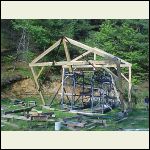
I came across these pics of one way to tip up a post frame. For us, ag buildings are exempt, that is where I get to have fun.
I welded hooks on the underside of some scrap channel and cast that flush with the pier top. The post base is 3 pieces of pipe and a long bolt for a hinge pin. Once it was up the base was welded to the pier.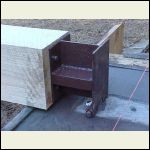
post_hinge_foot.jpg
| 
post_hinge_2.jpg
| | |
|
|
philpom
Member
|
# Posted: 26 May 2026 06:10pm
Reply
Just a thought, I'm no engineer so take it for what's its worth. I put my cabin on all piers but I often hear folks talking abut 6 or 9 piers etc. I put in 25 of them using those tubes and they are pretty deep with the tube mainly used to form the above ground section for uniformity. They are 24" to 36" inches deep and some of them weigh upwards of 700lbs a piece. The cabin sits directly on top of them except a barrier between the treated wood and the cement, in some cased just a few shingles and in others a wood block to level. Hurricane ties are embedded in the cement and attached to the building. We are on a hill side so some are a foot or less tall and other are 5ish feet tall. The last row only has 6x6 posts extending up to make the required height. Pouring cement posts 5-6' tall is absurd in my mind without going 5 or 6' down. If you are going to do it, just use a lot more of them and make sure they are deep, nearly 1/2 the height with plenty of bulk below grade. if you have soft soil then that's another consideration, we are very rocky, the earth grows them around us.
|
|
Asher
Member
|
# Posted: 25 Aug 2026 12:16pm
Reply
The best method I found to get the concrete into the piers was to use a stump bucket (triangle wedge style bucket) on a skid steer. I took a semi trailer mudflap and wrapped it around the end of the bucket to funnel it down even more. The end result was a ALMOST waste free pour for 10 piers, some over 48" tall.. Good luck..
|
|
Brettny
Member
|
# Posted: 26 Aug 2026 10:24am
Reply
We did something no one has mentioned. I mounted my electric cement mixer on my micro excavator bucket. We mixed and loaded at a comfortable height then lifted over to the tube to dump. 12in tubes 4ft in the ground, average tube was 5ft long. Two people including going to get pallets of cement and we where done and cleaned up in 5hrs..also no one was achy the next day. I lifted all 120ish bags my self. The difference was they where always at a comfortable height and I only ever had to move them about 4ft.
|
|
Asher
Member
|
# Posted: 7 Sep 2026 11:49pm
Reply
Another benefit to the stump bucket is it allows you to get directly under the mixer to dump.
|
|
gcrank1
Moderator
|
# Posted: 8 Sep 2026 03:32pm
Reply
That sure does look like a multi-tasking attachment
|
|
|

