|
| Author |
Message |
nymech
Member
|
# Posted: 3 Aug 2026 11:59am
Reply
Hello all, I have an offgrid cabin that is not connected to the grid. I have both a generator and inverter for power. I have a 100amp square D box with no main breaker. Currently I have a 12/2 wire going to a 20amp plug that has a 10/3 wire running to a 30amp double breaker with a 10g wire to jump the double breaker to power up both sides. The generator has a floating neutral, not sure about the inverter. My current inverter is 750w, planning on installing a 1000w pure sine. The neutral and ground are bonded with a grounding rod for the box and the generator. I have read other forums of people doing the same. I was planning on installing a 10/2 wire to run from the solar shed to the box with the ability to connect either the inverter or generator by plug in the solar shed. Just wondering if there is a better way to set this up. Thank you.
|
|
toyota_mdt_tech
Member
|
# Posted: 4 Aug 2026 08:29am - Edited by: toyota_mdt_tech
Reply
Most generators really dont have a neutral, just 2 legs producing peak voltage of about 70VAC, while peak to peak be about 120V RMS. Now inverter generators, this is done digitally and may be somewhat, squarish looking on a scope and some electronics may not work. Now if it was a single phase 220V non inverter with a center tapped coil, you would have your 2 legs and a neutral. But probably not going to happen. I know Honda makes some special OSHA job site generators, ie a EB2200i, identical looking to the EU2200i but OSHA approved.
So I would not bond your ground to what you think is neutral. The ground on your gennie you will find is just bonded to generator chassis, insulated from the AC. You can hook that to an earth ground
I ran mine like you want without the bond, insulated grounds and neutrals as if it was a sub-panel.
|
|
nymech
Member
|
# Posted: 4 Aug 2026 10:24am
Reply
For my main box in the cabin, the neutral is bonded with a grounding rod. The generator has a floating ground, with its own grounding rod, probably not needed, but since the generator is in its own small shed, wanted to protect from lightning. My concern is should I just remove the 30amp double and run to single lug in the box and just use every other slot. Currently only have 3 breakers. My generator does have a 220vac output but my inverter does not. I didn't see the sense in wiring for both.
|
|
Brettny
Member
|
# Posted: 4 Aug 2026 10:37am
Reply
Yes there is a better way. Get an inverter with transfer switch. This will automatically switch the cabin to generator load when the generator is running.
I also have a 100a square D box with no main breaker. My inverter wireing comes in as if its the main power and splits into both sides of the pannel via wire nut. You dont need to run this though a breaker into the pannel because your inverter has a overload as well as the generator. This is how mine is setup and confirmed by a residential electrician.
I took my system a bit further. I have a inverter with transfer switch and a remote start generator in a shed about 80ft away from the cabin. So at the push of a button I can start the generator, switch the cabin over to generator power and start charging the batteries. So easy my 5yr old does it. I had to put an indicator light on the shed To tell if the generator is running.
|
|
nymech
Member
|
# Posted: 4 Aug 2026 11:08am
Reply
Great, ty vm. My plan is to get a generator with autostart and set it up that way. Currently have to swap power plugs when running the generator. When I run the 10/2 wire I plan on removing the 30amp breaker.
|
|
Steve_S
Member
|
# Posted: 4 Aug 2026 12:57pm
Reply
My home is 120V. 100% offgrid with solar & battery with genset backup for "emergency" use.
Generator 120V/30A (L5:30) via wall mounted plug (10/2 wire) goes through a Square-D 40A breaker then to my Inverter/Charger which is set for 80A Charging to 24V LFP Battery bank. This pulls 120V/25A +/- 2A. * Genset is a Champion 5500W Inverter Tri-Fuel model.
Inverter/Charger (Pure Sine, Low Frequency) Out is 4000W out with up to 12,000W Surge capability (12000W@120V = 100A) This goes to a Square-D Q0270s 2/4 port box with Square-D 45A breaker (acts as Main Breaker from Inverter) that feeds another breakout pony panel on the powerhouse. This Pony Panel has a 120V/30A Breaker that feeds the house circuit panel via underground wires (6/3 & 8/3 set side x side for future capacity) and another standard 15A circuit to run the water pump (soft start 120V Grundfos SQ5 that is 300' deep).
See attached image (slightly out of date and does not show latest updates). [powerhouse side diagram]
* ONE AC Ground with all AC wiring is bonded & run per code ! This carries through to the Genset L5 plug -in as well. I used my Well Casing with is a 6" casing that goes 30' down and achored in solid granite. This same ground carries through to the house.
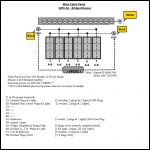
@house: The incoming 120V is presently on the 8/3 NMWU line with the 6/3 coiled up for future use. The House Panel is a Square-D Q06L100 Series G4 120/240V 6/12 Slot panel in which I use 1/2 size breakers. It is also Bridged internally for 120V use only. Now this panel is only restricted by the 30A Breaker in powerhouse but is wired properly for the house itself which is very low energy use and not a problem.
See panel diagram attached.
* Again this is using the only ground through the bonding.
Special Note:
My Cabin is NOT USUAL ! This house was built for hyper efficiency using Passive methods... thermally broken walls & roof, Rainscreen siding with full airflow & a a cool roof system that uses Convection to cool teh roof and pull air up from between the siding & structural walls. It sits on a Frost Protected Slab Foundation with R20 Foam Insulation encapsulating it, which also contains Radiant Heating PEX within it. The house does not need AirCon as it self cools and never rises above 27C/80F temps even when it is 40C/104F outside. This also requires little heating energy in winter as the Radiant System only has to run 2 cycles of 2 hours each to maintain 25C/77F throughout winter where I can see -35C/-31F outside.
This has been working well for over 10 years now. My solar system has evolved and now comprises of 2 solar arrays (2080W & 2370W) and a 55kWh Battery Bank of 7x280AH Battery Packs.
Electrical system is Code-compliant & Inspected per Ontario Canada Electrical Codes effective when built.
I can run my 4HP compressor or 120V MIG welder without any issues whatsoever and because of how I prewired, I am 240VAC ready with just a few swapped parts.
SPECIAL NOTES:
* You DO want a Breaker between Genset & the inside panels. Gensets can fail and cause shit and this is your safety !
* AC coming out of Inverter needs to go into a Breaker which can handle the max surge load your inverter can output. Watts ÷ Volts (4000W÷120V=33.3A) and then to the Distribution Panel which can be a Pony Panel with a main 240V breaker (pointless in this config).
* AC Ground should be SINGULAR and done according to code, either using a Rod, or buried Ground Plate or Well Casing (where appropriate). ALWAYS REFERENCE Your local electrical codes.
** AC Ground MUST be bonded across all panels, plugs etc per standard code rules.
*** WARNING !!!
Depending on your Inverter/Charger setup several different CGFI plug types may not work ! STICK TO EATON BRAND ! Alternately, if say you want to runa circuit to Bathroom which needs GFI then you can use a Square-D GFI Breaker (NOT cheap) for that circuit. Pending on your regional code, kitchen & possibly others need GFI as well, they are available in 15A & 20A models.
LESSONS LEARNED ADVICE (I've been at Cabineering a Long Time + Solar Offgrid stuff too). DO NOT UNDER ESTIMATE your needs... what they are "today" is not relfective of tomorrow. You can lay in extra wire etc today for tomorrows upgrades and that will save you Time & lots of $$$ (for instance 6/3 that I put in went up over 600% since then, and it's a 100' of wire, so NOT cheap) and all I have to do it uncoil, attach to new panel and voila! You can opverwire a panel like I did, it cannot exceed what the transfer breaker permits which in my case is 30A to the house.
I have everything common to any home... LED lights, fridge, stove, computers large screen TV etc... everything is Energy Star and efficient and I've never tripped a breaker.
Hope it helps. Good Luck
Steve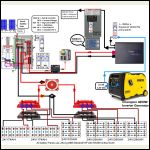
powerhouse side diagram
| 
Cabin Panel
|  | |
|
|
philpom
Member
|
# Posted: 4 Aug 2026 06:13pm
Reply
The previous post seems pretty comprehensive. I did wanna add, code wants a single bonded ground at the main panel. Multiple ground bounds not permitted.
I in the process of installing a transfer switch with a sub-panel at the cabin to make switching to Gen power easy.
At our main home I installed a 50 Amp inlet on the main panel @240v through a few large breakers, the neutral and ground bond in that box covers the Gen. It's an 11,000 watt constant generator, runs our entire decent sized home including the 5 ton AC. The AC would not turn on at all, not even a fan until I went through the panel. The new units expect and look for a proper ground/neutral bond.
|
|
travellerw
Member
|
# Posted: 4 Aug 2026 10:28pm - Edited by: travellerw
Reply
Everyone has said lots... My small 2 cents.
Now overkill is good (especially in electrical). I will just point out that 10 gauge wire can carry 30A by code. You could easily run 12 gauge for 750-1000W and still be well over code (12g can carry 20A by code).
If you have the money, then running 10 gauge is smart as it allows you to expand in the future (and give a big safety margin plus efficiency boost).
As others have said, an ATS (automatic transfer switch) is great. Some inverter have them, or you can buy them for about $100-150 on Amazon. Fire up the generator and it happens automatically (no moving plugs). Allows you to get fancy and build a remote start so you can start the genny from the cabin and not have to go to the generators shack.
The final thing I will mention (in case someone finds this thread as it sounds like you would never do this). Bonded grounds get strange if you ever want to charge an EV. The "floating" ground on a genset will reek all kinds of havoc even if you have a grounding rod and bonded ground at the main panel.
Welcome to the forum.
|
|
|
Brettny
Member
|
# Posted: 5 Aug 2026 09:46am
Reply
Quoting: nymech Great, ty vm. My plan is to get a generator with autostart and set it up that way. Currently have to swap power plugs when running the generator. When I run the 10/2 wire I plan on removing the 30amp breaker
Get a inverter charger then it will be a fool proof push button system then. Making things easy for other people who have no clue could be important one day.
|
|
Steve_S
Member
|
# Posted: 5 Aug 2026 10:39am
Reply
A Good Quality Inverter/Charger + Separate Solar Charge Controller is the best way for most "Canineers" because the SCC can remain ON to maintain batteries while no one is around and the Inverter/Charger can be shutoff is not needing to run anything OR placed into ECO-Mode which activates teh inverter when there is a demand (ie a freezer starting up).
Many people are attracted to AIO's (All-in-Ones) which have solar controller(s), Inverter & Charger all in one box. These are A-Typically less efficient for Inverting or Charging and their Solar Chargers are also not the most efficient either. Now they are fine for a full-time type situation where law of averages works out but they really fall short on low-use systems or those used in a part-time situation.
Victron Equipment is very efficient, solid, reliable well established and all of their gear interconnects & interoperates quite seamlessly, and they cover every option one can want or need. Yes, they cost more than some others but they are Tier-1 Quality goods and will last longterm.
If I was to build a new home, I would outfit it with all Victron equipment (except solar panels & batteries of course).
*** TERRIBLE NOTE: The US Maladministration has just placed sweeping restrictions on Inverters (grid to residential) and related equipment for import, while aimed at Chinese-made equipment, it is NOT exclusive to Chinese gear, it encompasses pretty much everything from everyone. What is in US Stocks/Inventory is being sold off and may not be replaced with new goods. Many "brands" people assumed were American will also be affected due to foreign content, especially if those parts are of Chinese origin. Some other US Brands were "Assembled in USA" using foreign parts and they are also cooked with these new regs.
Market pricing is already reflecting these new "rules/restrictions", and the sector shakeout has begun.
Hope it helps, Good Luck.
|
|
Steve_S
Member
|
# Posted: 5 Aug 2026 10:56am - Edited by: Steve_S
Reply
Message related to my Wiring Info that I posted above for a more clear explanation.
Standard Circuits (15A) are wired with 14/2. No more than 10 devices per circuit, including plugs, switches, lights, etc.
Kitchen Circuits (20A) NO SPLIT PLUGS (not allowed here) are run with 12/2, max 4 plugs per circuit, no other devices.
Fridge Plug is a dedicated 15A wired with 14/2. By our code. Nothing else allowed on circuit.
Washroom circuit(s) light/plugs are 15A CGFI, wired with 14/2, no unprotected circuits allowed.
Genset to Inverter circuit is 10/2 to handle 120V/30A + with no other "devices" aside from input 40A breaker between genset & Inverter/Charger.
Wiring between pony panels in Powerhouse is 8/2 (used 8/3 and deadheaded 1 wire, cheaper than rare 8/2 proper)
The 6/3 & 8/3 wire from Powerhouse to Cabin run parallel inside an underground conduit. 6/3 is coiled up for future expansion. These are both NMWU grade cabled.
!!! Electrical Codes vary between regions and you must look at the Electrical Codes that apply to YOUR REGION because that is what you have to comply with. Most insurance companies will want to see appropriate electrical inpsections/certifications for coverage. A simple screw up can "screw you over" so don't take shortcuts.
As I mentioned before, plan for future expansion/growth, our "needs & demands" constantly change. Costs are climbing at a crazy rate and won't be stopping any time soon. The wire you buy today WILL cost more tomorrow and in a couple of years, the increase is Heart Attack triggering... I am NOT kidding when I say wiring went up 600% in <10 years...
Hope it helps, Good Luck...
Sorry for all the reading. 
Steve
|
|
gcrank1
Moderator
|
# Posted: 5 Aug 2026 12:05pm
Reply
Your knowledgable input is ALWAYS appreciated Steve!
|
|
Steve_S
Member
|
# Posted: 5 Aug 2026 12:42pm
Reply
I "try" to help fellow cabineers when appropriate. Sometimes it is too much overload for some LOL...
|
|
Brettny
Member
|
# Posted: 6 Aug 2026 08:30am
Reply
One thing to keep in mind while building your generator circuit is this. A inverter charger charging a 48v battery bank at 70a is 3500w or 29a @120v. The inverter charger also transfers all the loads to the generator so even a few lights and a box fan would overload a 30a 120v circuit.
Honestly if you plan on buying a bigger inverter I wouldn't change much of your current system until that is done.
|
|
Steve_S
Member
|
# Posted: 9 Aug 2026 10:45am
Reply
Quoting: gcrank1 Your knowledgable input is ALWAYS appreciated Steve!
Well, it seems a case of Information Overload chased away the OP... I thought, maybe I wasted my time on this but hopefully it will be of use to others who wander in looking for this kid of info...
Oh well, I guess I'll only answer to those who are established here...
|
|
gcrank1
Moderator
|
# Posted: 9 Aug 2026 05:15pm
Reply
Somebody sometime will truly benefit from what you offer up here. Several times Ive gone back to review your wisdom because I just cant remember everything anymore; ie, take Steves Refresher Course.
WELL worth the re-read!
|
|
|

