| << . 1 . 2 . 3 . 4 . 5 . |
| Author |
Message |
paulz
Member
|
# Posted: 27 Mar 2026 06:42pm
Reply
Yep that’s him. I was recently out at Pt. Reyes, walked the earthquake trail showing the fault and fence from the 1906 big one.
|
|
DRP
Member
|
# Posted: 27 Mar 2026 06:43pm - Edited by: DRP
Reply
Ahh seems like you all have the connection. I posted on top of Paul but in the same light.
Ohh, I'm remembering something out west. Here we go;
https://fruitsandnuts.ucdavis.edu/sites/g/files/dgvnsk12441/files/391-51.pdf
My wife was out at the chestnut orchard today. They are going to remove and thin stuff that isn't working. I have a request in if there is anything sawable.
|
|
paulz
Member
|
# Posted: 27 Mar 2026 07:15pm
Reply
Is this that black line disease?
|
|
MtnDon
Member
|
# Posted: 27 Mar 2026 08:50pm - Edited by: MtnDon
Reply
Interesting article on the walnut grafting, DRP. 
A little bit of that may be spalting from fungi, but not exactly the black line disease in DRP's link. I think most of the faults we see in that piece are cracks. That artist is in Hawaii. He has "stitched" the cracks with slices of koa wood. I have no idea how he does those thin pieces, although it is a rather big piece, so the stitch slices are bigger than one might expect. https://www.martinandmacarthur.com/products/koa-messages-bowl-2333-by-aaron-hammer
I have seen contrasting color wood bowties used to patch and bridge cracks. I have trouble making those when the wood is flat. I do fill cracks with a colored CA glue at times. Sometimes a little epoxy. I have black, dark brown, and light brown medium-thick CA. Apply a little to the crack, let it run in, and then zap with accelerator. Sand or turn as needed.
Yes, we hiked the earthquake loop trail and poked around the area. Interesting place. Your home and/or cabin is in that area. It is a nice area; I liked visiting, but am happy where we are in NM.
|
|
DRP
Member
|
# Posted: 29 Mar 2026 10:59am
Reply
Yes the black lines you see in that turning are spalting, the early stages of decay, usually from one of the white rot fungi. The black lines are the edges of each affected zone. It can be beautiful for accent pieces. I have seen people say that it makes the wood more stable and durable, no. Those are the rotters. Before we can even see the fungi at work they have consumed fibers and decreased the strength of wood. For non structural stuff that may be of no concern but I did see one mention of spalted wood being "superior for decking and beams" nothing could be further from the truth so really that is just a reminder to be mindful of sources.
For turned work it really shines and I've seen some beautiful slab tables made from spalted wood. With the decrease in fiber length and strength the wood is more dimensionally stable, in the same way that low density wood tends to be more dimensionally stable than high density wood... wood substance shrinks and swells in response to moisture, the fungi have digested some amount of the wood.
|
|
paulz
Member
|
# Posted: 10 Apr 2026 09:24am
Reply
On ironwood: Talked to my sister, who lives a few hundred miles away. The deck at her house is built in ironwood, from Hawaii she says, doesn’t know the species.
I’m still waiting for a use of my little chunk. Weighs 3-4 pounds, still surprises me picking it up.
|
|
DRP
Member
|
# Posted: 20 Apr 2026 10:22pm - Edited by: DRP
Reply
I have a cousin I see every few decades that lives in HI. That's about the extent of my local knowledge  . .
A couple of searches pointed to the non native (Australian) Ironwood, "She - oak", as an introduced species in HI. And I see why, I would see that end grain and call it oak. It is not really an oak but the rays are distinctive, does your wood have those on the end grain?
http://www.hobbithouseinc.com/personal/woodpics/sheoak.htm
If that is it I remember someone on a forum from NZ posting pics of sawing it and making some really nice furniture. It was also apparently "harder than the hubs of hell".
|
|
MtnDon
Member
|
# Posted: 21 Apr 2026 11:51am
Reply
sheoak is supposedly really fine fuelwood too. Burns with very little smoke. It also makes great charcoal according to an Australian government publication.
https://www.agriculture.gov.au/sites/default/files/abares/forestsaustralia/publishing images/forest%20profiles%202005/casuarina_forests_2005.pdf
|
|
|
DRP
Member
|
# Posted: 7 Aug 2026 10:01am - Edited by: DRP
Reply
This guy has shown up on my youtube feed a lot recently, good stuff;
https://www.youtube.com/shorts/mGuVm1GwJdg
Notice a real foundation even under a small building.
If the firedoor hardware arrives next week we should get a CO, woohoo. The most expensive door on the project thus far is the 2 hour rated fire door to the closet under the stairs. I've been working my way out of the apartment. I watched this red oak tree grow up and then lean over our house. This is it's new home.
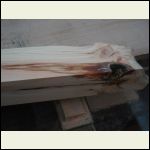
While scrolling thru pics there was another wood defect I don't think we have talked about, massed pitch. Conifers use resin, pitch, which is not sap, to seal wounds and protect the living tissue. The epithelial cells that line resin ducts secrete the protective resin. They are also the last cells to die, they can live and pump resin for up to 6 months after the tree is cut down. Anyway, massed pitch. When grading or sorting lumber, if you see massed pitch find the reason for it. In this case the top of the tree broke and the pitch is trying to seal the injury. I've had massed pitch highlight a timber break in a large rafter before, something that could have been a real strength/safety problem. I suspect they dropped the tree over another tree or rock or stump and cracked the tree without knowing it. The cut tree still secreted pitch at the site of the injury.
Amber is fossilized pitch, often with fossilized insects trapped in it.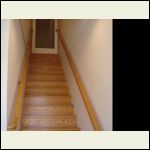
stairs.JPG
| 
MassedPitch.JPG
|  | |
|
|
| << . 1 . 2 . 3 . 4 . 5 . |

