| . 1 . 2 . 3 . >> |
| Author |
Message |
TNwoodsman
Member
|
# Posted: 23 Dec 2025 02:27pm - Edited by: TNwoodsman
Reply
Hey guys I am soon to start the foundation of my 18x24-ft cabin. Some of the background info is 10 ft side walls. 12 by 12 pitch. Foundation will be 3 rows of 4 posts that are PT 6x6.
It will be fully sheathed. Floor joists are 2x10 with 2 x 2x10 rim boards on the exterior and 2x10 floor joists.
Originally, I was going to place a 24 foot 6x6 on the exterior posts and then place the 2x10 joists on top of the 6x6 beam that spans the 24 feet side. To me this seemed super strong. Is this way overkill? Should I just place the 2x10s on my 6x6 posts? The posts are one on each end and two in the middle every 8 feet to total 4 6x6 posts along the 24 foot side.
I love the sound of the 24 foot 6x6 beam but that won't be cheap and super heavy and harder to load/haul. If I went this route, I would anchor the 6x6 beam to the 6x6 posts and then anchor the 2x10 rim boards to the 6x6 beam.
If I may ask one more question....ridge board will be 2 2x10 with 2x8 rafters. Does this sound sufficient? Roof will be sheathed with osb or plywood and then metal roof.
Thanks for any and all input!
|
|
DRP
Member
|
# Posted: 23 Dec 2025 04:47pm
Reply
We've had several threads recently with wobbly piers, misplaced piers, piers without footings. Pier foundations are non code for good reason. The pic below is the code alternative, a "permanent wood foundation".
Do you know the local frost depth?
How much slope is there across the footprint?
6x6's are graded as posts not beams. I can do the math but at that span and load they will not be strong enough. Going back to the foundation I mention above, it supports the floor(s) uniformly along its length... before we go sizing members let's find out what the design and loads are.
10' sidewalls sounds like you plan on a loft above?
Are there porches or decks attached to the building?
What is the design snow load? If you don't know you can get it here;
https://ascehazardtool.org/
Use risk category I.
|
|
TNwoodsman
Member
|
# Posted: 23 Dec 2025 05:03pm - Edited by: TNwoodsman
Reply
Thank you for the reply.
The frost line is 10 to 12 inches in that part of southern TN/bordering Alabama.
We get about 2 or 3 snow falls a year at best here in southern TN. Usually a couple of inches.
According to that link, 18 lb/ft2 was the snow load value.
I was going to do a loft with 2x12 southern pine using jack studs and supported underneath by framing from kitchen, bathroom, and bedroom walls.
I was going to have a 4 foot porch.
I should mention that I am framing with 2x6s, 16" OC.
Happy to answer other questions.
Thank you!
|
|
DRP
Member
|
# Posted: 23 Dec 2025 08:20pm
Reply
Cool, there is enough to start.
Some code/insurance stuff.
Do you have building inspections, do you need plans/ permit?
Generally...
Minimum footing depth is 12".
Minimum design load is 20 psf (wind)
Porch, is a roofed thing with a floor under it... floor + roof load. The reason for that question and distinction, all that is adding load to the "6x6" (not!). (There's some portion of a main floor, loft floor, main roof, porch floor and roof on that 6x6 at 8' span).
A cheap rototiller can dig the trench 12" deep. Or a mini ex, or hire it done. I've put block foundations under chicken coops here, we are not that deep. Pour 8" deep with 2 rows of rebar on chairs, 2 rows high of block minimum on that if no slope. How sloped is the spot?
That puts bracing foundation walls under the bracing, sheathed, perimeter framed walls above (the code callout). You can put porches, floors... all kinds of load on a foundation wall without worrying about beam bending load. The cost of the real dimension beams and posts goes against the cost of what I'm proposing.. the beauty of being in the South, its easy to do a conventional crawlspace and get a strong foundation supporting, pretty much whatever you add on. If that works, design gets easier (you get back into code provisions instead of winging/ engineering it) ... would you do that foundation?
|
|
MtnDon
Member
|
# Posted: 23 Dec 2025 10:10pm
Reply
DRP knows about structural design and safe practises.
You mentioned a 4 foot porch. That width works fine on our cabin, but it is just a walkway from the door to stairs. No room for sitting.
|
|
gcrank1
Moderator
|
# Posted: 23 Dec 2025 10:21pm
Reply
Ime 4' is a bare min and if the rain isn't coming straight down it isn't quite enough.
|
|
TNwoodsman
Member
|
# Posted: 23 Dec 2025 10:35pm
Reply
The build site is pretty remote. Originally and ideally, I was going to pour concrete piers with sono tubes but I have no running water or electric. I do have a creek about 150 yards away. I dont think a concrete truck could get to where I am building. Its up on a bluff but the ground is fairly level once you get up top. Im crossing my fingers on what ground I hit once I start digging post holes. It will be chert and sandy or ill hit rock.
This cabin is a weekend retreat for me and my young kids. It won't be lived in full time. No inspections or codes or permits. Having said that, I still want it to be safe and strong and while I want to build within code as much as I can to be sure its done right and safe, im not bound by them.
I have a couple of different plans that I have gleaned from. One is a 16x20 cabin and one is an 18x24 adirondack cabin that a builder sells in upstate New York. Obviously has plans reference deeper posts for deeper frost line.
My best bet (and easiest) is posts. My plans were to dig 24 inches deep. Then 6 inches of crushed rock and then bury my posts 18 inches. This keeps me 6" below frost line. Ill then have 18 to 20" of the post above ground so roughly half the post will be buried.
Going back to your other question about the porch. The porch will have 4 6x6 posts as well and the plans im referencing uses 2x8s for the floor joists. 16 8x8 posts total. 12 for the cabin and 4 for the porch.
Thank you for your time and responses.
|
|
TNwoodsman
Member
|
# Posted: 23 Dec 2025 10:49pm
Reply
I was going with 4 foot due to footprint and space but also cost of materials but I suppose it wouldn't cost more to go bigger. I could go 6 feet. Im not hard committed to 4 feet.
|
|
|
TNwoodsman
Member
|
# Posted: 23 Dec 2025 10:50pm
Reply
I appreciate the real world advice.
|
|
Grizzlyman
Member
|
# Posted: 24 Dec 2025 01:08am
Reply
Continuous foundation or slab is best- but lots and lots of cabins are built on posts(mine included). It’s not always feasible and posts are just fine. (You’re not building the taj mahal). 2x10 ridge w 2x8 rafters will work well for that span. You can space 2’.
Keep us updated. Love to see the new builds!
We did an 8’ screen porch and it’s barely enough room.id bump the 4’ to 8- but that also depends on what you want to do with the porch. For sitting 6’ is fine… but for a table or something more 8’ would be the minimum.
|
|
paulz
Member
|
# Posted: 24 Dec 2025 08:15am
Reply
Quoting: Grizzlyman For sitting 6’ is fine…
Mine is 6’. An lp cooktop, electric cooler and a chair, solar panels above.
For company there’s a large deck in front.
|
|
DRP
Member
|
# Posted: 24 Dec 2025 10:29am - Edited by: DRP
Reply
I still want it to be safe and strong and while I want to build within code as much as I can to be sure its done right and safe, im not bound by them.
My best bet (and easiest) is posts.
Need to pick one, strong and safe or wishful thinking.
The failure of most of these DIY foundation notions is the unbraced/poorly braced posts or piers. You don't see real builders doing that, give that some thought. As for plans, check the designers qualifications. Anyone can sell a drawing, just be mindful. Do they reference the design loads used and code version, those would be my first cues. If I can get the wood in I can get concrete in. That's all just stuff to think about as you wade through the weeds.
Let's explore what a real post foundation would look like. How do modern pole barns work? In trade language a modern, engineered pole barn is a "post frame" structure to distinguish it from the old DIY farmer designed "pole barns" that don't have a great track record.
They run the posts from the footing to the roof, unbroken. The sheathed walls and roof brace the posts. Their design relies on "diaphragm and frame interaction".
Time to go play outside, this is a quick start to show the concept.
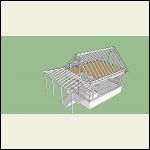
Well, there was another old 18x24 doodle on the stick, more grist for the mill
edit, no ridgebeam shown yet, we don't have enough info to check that yet.
18x24PostFrame.jpg
| 
18x24_2_story_shop_w.jpg
|  | |
|
|
TNwoodsman
Member
|
# Posted: 24 Dec 2025 11:22am
Reply
DRP,
If I revisited the sono tube concrete pier idea:
What size sono tubes would you recommend? Whats the smallest diameter I could safely get away with?
And is 3 rows of 4 concrete piers 18 inches deep enough?
If I had to go the 6x6 PT posts route, would adding more posts make this safely feasible? Posts spaced ever 6 feet? 8x8 posts?
Thank you.
|
|
gcrank1
Moderator
|
# Posted: 24 Dec 2025 11:29am
Reply
Fwiw and ime a cabin notion becomes bigger and far heavier than originally thought. And we continually get new members with pics of post or pier problems, often on a new to them cabin.......
You pretty much get One Shot at getting your 'foundation' right, and minimum specs is just that, min.
|
|
DRP
Member
|
# Posted: 24 Dec 2025 12:37pm
Reply
If you want to do what you just described the right and safe way... and code says, hire an engineer. You're probably going to be 5-7' underground with a lot bigger sonotube than you think.
I take that money and use it towards doing it conventionally. Notice in my sketch it took 3 rows of beams vertically to make it work with post frame, floor beams, loft beams, roof beams. A conventional continuous foundation eliminates all that lumber. The load path is down to uniform support on foundation walls. It is safer, stronger, far more capacity and abiity to add on.
60F and the skid steer fired right up, got 6 logs to the mill so far.
|
|
TNwoodsman
Member
|
# Posted: 27 Dec 2025 02:14pm
Reply
If i do a continuous foundation with footers, how wide and deep does it need to be? Im assuming at least 12 inches deep and wide enough for concrete blocking but im sure there's a calculated width.
I have definitely taken what you guys have said to heart and paused my build and continued to do more research and learning.
I really wanted to stay away from concrete. If the concrete trucks can fit through the 3 cattle gates to get to the build site, ill need concrete pumping for the jobs site. Plus the cost of the labor for the forms and concrete job. Costs of concrete blocking. I know at the end of the day, the cost is irrelevant if I build something that doesn't hold up.
Hauling in concrete myself is the issue of no running water and ability to mix it. Im deflated at this point about stressing over the foundation.
|
|
TNwoodsman
Member
|
# Posted: 27 Dec 2025 03:25pm
Reply
DRP,
Acknowledging that a continuous foundation is the best way to go, can I build my structure sturdy enough with posts on concrete piers? Some of the architectural plans that I have looked at that give a pier foundation option use concrete piers with posts attached to them. Im going to assume this is better than me just using 6x6 pt posts in the ground, if nothing else for the rot factor and getting the posts out of the ground. I have learned from you that lateral stability is one of the issues with post foundations. They hold great vertical loads but we are worried about the lateral loads (the load between piers). Can this be mitigated with braces? Cutting a 6x6 at a 45 degree angle and attaching at the bottom of the post and then attaching to the rim boards at a 45 degree angle? Like post and beam construction?
I know I need to figure up a total weight of the structure comprised of dead load, live load, and snow load. I know I need to know the soil bearing capacity of my area. And then I need to calculate the total area of concrete piers I need to hold the structure up. This number is divided by surface area of a given sized sono tube to calculate size and number of piers needed.
But I dont know how to begin to estimate the weight. Are there general rules of thumb to estimate a worst case scenario of weight? The structure is 18x24. Ill go with 1 foot overhangs on the roof so I know the roof square footage will be slightly bigger. I think you said ill use 20 psf for the roof since this is minimum for wind load. Can you help me with these calculations to understand my concrete pier needs? I know the amount of surface area needed for support of the structure will help dictate size of sonotubes. Since frost depth is 12 inches, do I go to frost line or bury them deeper?
Thank you for your time and input.
|
|
DRP
Member
|
# Posted: 27 Dec 2025 08:33pm
Reply
If the concrete trucks can fit through the 3 cattle gates to get to the build site, ill need concrete pumping for the jobs site. Plus the cost of the labor for the forms and concrete job. Costs of concrete blocking.
Let's start there... you don't need any of that.
Typically we use the soil as the form. If you can dig a square sided trench that does not collapse, the soil is the footing form.
I'm in the Blue Ridge and we have some difficult sites at times. I don't necessarily have to get the truck in, I have to get the concrete in. The worst was my own house, I was young and none too bright. The truck failed to make it up and I didn't have a plan B. We loaded drums and trash cans in the back of the 4wd pickup and did a bucket brigade out of those up top. We emptied a 7 yd truck that way and yup 4 of us were smoked at the end of it. I had a dozer and logging chain to pull the truck up backwards for the slab pours. There is nowhere for a big truck to turn around up top. We have planked over and blocked under cattle guards and bridges. I've used tractor buckets and bobcat buckets to shuttle from the truck to the site, and I've used line pumps and crane pumps when we have to, you don't need to. Shuttle it in with a rented skid steer if the truck can't make it. That's all just part of the job.
From your description 12" is bottom of the footing. A typical footing is 8" thick x 16" wide. The minimum for this structure is 6" thick x 12" wide, see below. Lets figure from there, that is going to be worlds better than piers. A little more than a yard and a half. Minimum for a truck delivery here is 4 yards, I would have to pay a surcharge for that small a pour. You could also get 65 sacks of sakrete and a drum of water and hand mix it. You can load 20+ sacks in the back of a truck per trip. Or, go with a 16" wide footing and pour ~10" thick, dig your internal girder pier footings, and call a 4 yd truck. The wider footing allows more room to correct is you are off dimension or out of square a little.
From there, a minimum of 2 courses of 8" block, ~65, get 80 to allow for internal piers. Preferably go a row higher for more comfortable crawling later. Foundation vent each end and an access hatch either through the foundation wall or down thru the floor inside.
This is going long but a little background. I've had to replace the foundation under more than a few houses. Usually I've dug under a section, support structure and pour that footing by hand, working my way around the perimeter. I would get 25 bags on the way in, mix and pour that. Eat on the way back to the building supply for the afternoon 25. This is not a big job at all.
https://codes.iccsafe.org/content/IRC2018P7/chapter-4-foundations
|
|
TNwoodsman
Member
|
# Posted: 27 Dec 2025 09:08pm
Reply
DRP,
Thank you for your responses. Unfortunately you slowly have me entertaining the idea 
To clarify. 12 inches is the bottom of the footing. So I need to dig down 12 inches and then pour the footer 8 inches thick?
So there will be 4 inches from the top of the footer to the ground level?
Later on, when I want to run lines in and out I will need to dig under the footer to get it under the house?
Thank you for your responses.
|
|
TNwoodsman
Member
|
# Posted: 27 Dec 2025 09:21pm
Reply
Internal pier footings will be the row in the middle?
Thank you.
|
|
DRP
Member
|
# Posted: 27 Dec 2025 10:39pm
Reply
Yes, the girder running down the center can be on piers... I would probably do a dropped girder vs a flush girder there. That is setting the joists on top of the center beam rather than with a flush girder the joists attach to either side of the girder with joist hangers. It allows for easier plumbing and wiring in the joist bays, but, that means there is a low obstruction under the bottom of the joists, probably a foot, and there is also a minimum distance for untreated wood to dirt.
R317.1, Girders closer than 12" or joists closer than 18" have to be treated.
Nothing wrong with using treated either way and 12" is tight to get under. There's the pros and cons of flush vs dropped, that affects the height of the piers down the center.
Read R502.2.1 and R502.7, with joists lapped over a dropped girder you still need to block between joists over the beam to laterally help prevent them from rolling over.
If you can, run a 2" larger sleeve of pipe below the 12" footing bottom that will provide a "relieving arch" for the pipe to pass through later. Drive a pin so you can find it later.
The ground underfloor should be bare earth, nothing to rot, they smell decay. Ideally you want to be a raised pitchers mound under there, slight dome, raked smooth for comfort. High and dry. 6 mil plastic on the ground, you don't want vapor or anything else the ground holds coming up.
I found a couple of pics, was hoping to find one of the trench, 2 runs of 1/2" rebar on wire "chairs" to hold it off the bottom. That is our "ready to pour" inspection point. This is just after the pour and foundation starting. A little forming where we needed to hold the edge. Vertical rebar to tie from footing to your anchor bolts ties it all down to the footing for wind hold down.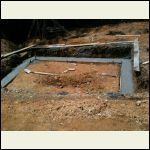
Footing1.JPG
| 
foundation.JPG
| | |
|
|
Brettny
Member
|
# Posted: 28 Dec 2025 05:26am
Reply
I would do a continuous poured foundation. It just isnt needed. Sono tubes poured right up to the bottom of the girders will be totaly fine..as long as theres no to much sticking out of the ground. As your frost depth is prety shallow.
I would not do any wood in the ground or a concrete tube with a post on/in it.
Build the bigger cabin. No one ever wished they went smaller. In in my 20x32 with porch right now and wish I went 4' deeper and wider.
|
|
TNwoodsman
Member
|
# Posted: 28 Dec 2025 11:51am
Reply
DRP,
Thank you for the explanation and the pics.
|
|
DRP
Member
|
# Posted: 28 Dec 2025 01:52pm - Edited by: DRP
Reply
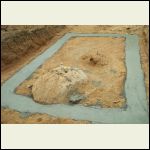
Here we go, this is one with the trench just about ready to pour. The rebar is tied to the chairs, I've double clamped the ground wire to the footing rebar on the left long side to create a "ufer ground" rather than having to drive a ground rod later. The client liked the rock, it is still there.
There are grade stakes between the rebar all the way around, we shot them in with a laser so the top of the pins is the top of footing level. I can check from pin to pin with a straight board. I think those were old log home screws, rebar cutoffs will work as well. No wood in the footing pour. Remove all forms if you use any and do not use wooden grade stakes.
ReadyToPour.JPG
| 
Footing2.JPG
| 
foundation2.JPG
| |
|
|
DRP
Member
|
# Posted: 28 Dec 2025 10:14pm - Edited by: DRP
Reply
Some more old pics.
A sketch of a permanent wood foundation on a concrete footing, the codebook sketch above shows a section view with a gravel trench footing. I've worked on both and prefer concrete just for ease of launching from something firm I've snapped lines on.
We were in deep schist on the next job. A ca.1911 hall and parlor farmhouse, the entire dry stacked foundation was a mess, the end in the pic was collapsing into a stoop height root cellar as the weak vertical rock spalled away. Next shot is the footing formed with a drain line running from outside the wall, under the footer heading towards a sump pit inside the basement. The sack wrapper is a poor relieving space maker. I also knew that footing wasn't going anywhere. No grade stakes there, the form boards are levelled to footing height. Forming is more work but easier to screed level the day of the pour. That is also the terroir of french wine country.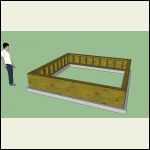
pwf12x12.jpg
| 
matthewsdig2.jpg
| 
Matthews_SWfooter.jp.jpg
| |
|
|
TNwoodsman
Member
|
# Posted: 28 Dec 2025 10:19pm
Reply
Thats cool looking. Thank you.
|
|
spencerin
Member
|
# Posted: 28 Dec 2025 10:59pm - Edited by: spencerin
Reply
My foundation is foundation-grade 6x6 treated wood posts in the ground with doubled up 2x10s spanning 8' between posts, no additional bracing. No problems to-date. At the same time, the posts are 3' deep and the cabin itself isn't far up off the ground, so it holds against lateral forces well.
I don't want to throw you off the track it seems you're now on with concrete, but a wood pier foundation will work well if done right. I'm a fan of them given their ease and cost.
|
|
DRP
Member
|
# Posted: 29 Dec 2025 07:00am
Reply
ease and cost
Vs right and safe.
These descriptions have more DIY problems than you all recognize. It starts a path of poor decisions.
My question would be, how does one do that right and safe?
|
|
Brettny
Member
|
# Posted: 29 Dec 2025 07:25am - Edited by: Brettny
Reply
The problem I see with a continuous porured footing/foundation like that is unless your frost depth is extremely shallow you basicly have the same frost proofing as blocks at 3x the cost and 5x the labor. That style would just never make sence with my 4' frost depth unless I needed/wanted a basement.
Know the cost per 6x6 foundation grade post and cost vs sono tubes?
|
|
DRP
Member
|
# Posted: 29 Dec 2025 08:02am - Edited by: DRP
Reply
I can't make heads or tails of that other than to say frost is just one concern and you pulled numbers out of thin air.
The question remains, how does one do piers safe and right? ("according to accepted engineering practice")
There is a cost for that design and then the cost of actually doing things safely and correctly. What you all are trying to talk people out of is time proven. What you are trying to talk people into doing is not safe or correct. Time has shown the problems which is why those designs require engineering.
When the real teacher gives the test, one builder's or one designer's entire body of work gets wiped while another's passes the test. Why do I cite the time proven ways and use them? There is some level of responsibility when we do and when we advise.
|
|
| . 1 . 2 . 3 . >> |

