| << . 1 . 2 . 3 . >> |
| Author |
Message |
Steve_S
Member
|
# Posted: 29 Dec 2025 08:29am - Edited by: Steve_S
Reply
An Observation with a bit of surprise.
The Elephant in the Room no one wants to talk about.
Any foundation, be it piers, concrete or rubble or even just a "simple slab" and others ALL depend on the Soil type "Under your feet" not a 1/2 mile or more away. It also depends if you can reach Stable Bedrock or not and last but not least, what the site drainage & flows are like with regards to the soil and if it will be affected by heavy saturation.
Simple things that get missed (because some won't consider it, for whatever reason) is WHY are piers Round and not Square and what effect that can have on piers... Just a bit of structural engineering stuff, feel free to ignore that.
While I haven't "read all responses" even piers need footings, most especially if you are not reaching stable bedrock. Footings like "Big Foots" or concrete base pads. See image attached. REF: https://www.bigfootsystems.com/index.htm
Forget building on top of "Sandy Loam" because it is injherently unstable but if you excavate and solidify the base several feet deep you can.
SIMPLY PUT: You will have to dig yourself a hole at least 8-10' deep to really know what's under your feet and then plan accordingly. Sometimes the best option is a Floating Foundation (different type of slab) because it can work very well on softer / more permiable soils.
RE: A floating foundation is a type of foundation that consists of a rigid structure, often made of reinforced concrete, which is set at a depth where the weight of the soil removed equals the weight of the building. This design allows the building to "float" on the soil, similar to how a boat floats on water, making it suitable for areas with soft soil or seismic activity.
Build it ONCE and do it right the 1st time... Just some things to consider.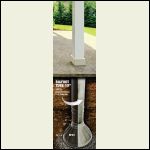
Big Foot form with Tube
| 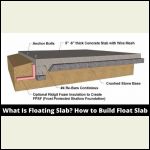
Floating Slab Foundation
|  | |
|
|
DRP
Member
|
# Posted: 29 Dec 2025 11:57am
Reply
A couple I built for in NC was originally from MN. They inherited some family land and were talked into a Frost Protected Shallow Foundation for a vacation cabin. They then had to rebuild the foundation after it heaved. Here's the reason:
R403.3 Frost-protected shallow foundations.
For buildings where the monthly mean temperature of the building is maintained at not less than 64°F (18°C), footings are not required to extend below the frost line where protected from frost by insulation in accordance with Figure R403.3(1) and Table R403.3(1). Foundations protected from frost in accordance with Figure R403.3(1) and Table R403.3(1) shall not be used for unheated spaces such as porches, utility rooms, garages and carports, and shall not be attached to basements or crawl spaces that are not maintained at a minimum monthly mean temperature of 64°F (18°C).
The prescriptive soil bearing table is at R401.4.1
We typically use 2,000 psf for good soil and a geotech when someone wants to build where one should not build. Keep in mind that point loaded piers generally have higher loads than uniformly supporting strip footings. Pier loads also vary considerably in relation to one another.
Without design the bottom of the turned down edge is the portion of a monolithic pour used for bearing calculations.
|
|
gcrank1
Moderator
|
# Posted: 29 Dec 2025 12:07pm
Reply
Excellence is often the victim of (perceived) good enough.
The quality of the actual build begins with the foundation.
All the time, work, money and love that builds upon a poor foundation may be a waste.
|
|
Steve_S
Member
|
# Posted: 29 Dec 2025 04:13pm
Reply
FYI: The Floating Slab image & talk was NOT for a Frost Protected Slab Foundation liek I have, they are similar in basic design but an FPSF Foundation is also sitting on top of a minimum if 2" think High Density sheet foam (I used 4" for R20). Insulation also runs up along side to teh surface level and has a minimum of 24" "wings" out from teh foundation to prevent frost creep from going underneath. Remember I am a hell of a LOT further North than most of you up here near the Algonquin Park, North Eastern Ontario where -30C is just a typical winter day when it's not snowing... Although, it is seriously messed up this year, bouncing (flip flopping fast) from deep Negatives to low Positive temps...
|
|
spencerin
Member
|
# Posted: 31 Dec 2025 03:53am - Edited by: spencerin
Reply
From what I read, the OP initially wanted to avoid concrete due to its relative complexity and higher cost. Would concrete piers or a solid concrete foundation be better in the long run? Yes. But that doesn't mean a wood pier foundation is by default a bad idea. It's case specific. His seems to be a smaller, single-story cabin, and assuming on flat (enough) land and proper soil - foundation-grade posts in plastic sleeves sunk 3' deep on top of compacted gravel footings will last a long, long time, and still be safe. Tens of thousands of pole structures and small cabins/houses have been built this way. I mean I've seen a guy on YT yank out and replace something like 12 concrete piers under his cabin because the originals were poorly poured (no pun intended) and broke. Concrete piers can fail, too, especially if a novice is doing it, no offense to the novice.
Anyway, point is, don't knock an option because it's not as good, not-as-good can still be acceptable. Just present pros and cons and let the OP make an informed decision.....
|
|
Brettny
Member
|
# Posted: 31 Dec 2025 07:23am
Reply
Quoting: spencerin YT yank out and replace something like 12 concrete piers under his cabin because the originals were poorly poured (no pun intended) and broke. Concrete piers can fail,
I believe I saw that video also. Looked like one crappy job. I also believe those could have been "dry poured" by the previous owner so wouldnt count on all piers turning out like this. Dry poured or a serious water issue in freezing temps causing bad Spalding. The fist thing that's needed for any cabin build is site prep. Bad drainage, poor surface water control and even dead/cleaning trees are all easier to take care of before your build.
If the OP wants no/minimal concrete I would just build on PT cribbing or blocks and expect to have to re level things the first few years. It is way easier to relevel a place vs having to remove a badly heaved concrete foundation. Either way I would leave enough room to sit up under your floor joists.
|
|
DRP
Member
|
# Posted: 31 Dec 2025 06:10pm
Reply
How do you do that safely and right?
|
|
TNwoodsman
Member
|
# Posted: 31 Dec 2025 08:09pm
Reply
Yes! The discussion floor is open!
|
|
|
DRP
Member
|
# Posted: 6 Jan 2026 05:56am
Reply
I came across this yesterday and watched till I glazed;
https://www.youtube.com/watch?v=27H6TNmZUUg
That is using the code referenced engineering standard ASAE EP 486.3 that deals with post frame design and he is the professor that most frequently handles post frame design.
It looks like this may be the shortcut to do the engineering required for that method. Gonna take more than one night for me.
|
|
Aklogcabin
Member
|
# Posted: 6 Jan 2026 09:28am
Reply
Holly macaroni. Guy wants to build a cabin. 16x24 cabin. And gets his ideas beat up because he isn't building above code.
I kinda suspect most cabins are not built to codes. Or inspected. Maybe some things he could do differently but I think he'll be ok. Seems like there is some thought about it.
I'll say from my personal experience. Built a remote log cabin. 16x24 and 10' tall side walls. 12/12 roof pitch. Used cedar utility poles. Big ones. Would have been impossible to use a cement foundation. And very impractical. Poles are 4' deep. And have cement for backfill. And the cabin floor is 4' off the ground. Bear issues. And the deep snow.
This little cabin is doing great. We have lots of snow there, lots n lots. Ground frozen half the year. And big earthquakes too. Last big one was 7.2 , and there have been others in the 6 range.
If I had to follow codes. Probably couldn't have built a log cabin. And it would have been impossible. We would not have had a cabin to enjoy.
I guess I'm writing this because if I was planning a cabin and asked for advice here and got told everything I was doing was just going to waste my money n time because it's just going to fall over. And probably hurt someone really bad. And made to feel that I had to follow code, or else. Well I'd probably just not come back.
Just my thoughts folks. And I kinda suspect that there isn't any folks in our parts or very few that are concerned about meeting building codes for their cabin. Glad I live in AK
|
|
gcrank1
Moderator
|
# Posted: 6 Jan 2026 05:02pm - Edited by: gcrank1
Reply
All good practical points.
My 1983-84 build was a 12x24, a conventional deck on silo 'block short stacked piers' on a sand and gravel hill with only a slight pitch, leftovers from the last glacier in WI I think. It was to be a simple 'barn timber' frame, 1 story, shed roof. It morphed into having a 12x12 loft with a steep pitch. 30+ years on and I only had to shim under at one point because the door, sorta centered on one one side, was sticky in the jam. I admit to having been pretty ignorant of the foundational issues at the time and in retrospect should have used a lot more blocks.
That was on my mind when I prepped in April 2024 for the prebuilt milled log 12x28 cabin we had moved in (a different site but similar ground)... I compacted the area to be under the cabin lengthwise beams by repeatedly running the tractor c/w 650# rear ballast weight and the FEL full off the crushed limestone base back and forth for hours. Then I put down that crushed limestone each side, compressing that as I went to a finished to 9-12" deep. With that slightly domed I rough leveled then placed 18 silo blocks, 9 per side (that made almost a continuous support, only a slight gap between each). Each of those needed to be laser leveled XYZ, that was futzy! I got them +/- 1/8" on that 12x28 footprint.
The cabin rolled right in and on beautifully.
So, all that to say Ive done 2 cabins with totally 'floating foundations' and no 'engineering'....maybe my bad? We will see, once again, but based on my 1st build 30+ years on and the Waayyy better job I did this time I am Very Confident.
That all said, the cabin we replaced with this last project was an owner built (poorly) 16x25ish (a nice livable size for us 2) with 12 posts in the ground, 3 rows of 4 on the length. Think a diy 'pole building' style with a floor 18" above grade. It was a shack Not Worth my refurbing, thus the new cabin. When we tore it down 3 of those posts on the outer sides were well rotted. It was only about 10yrs old.
I had wanted to do a comparable size but realized (wisely) that I couldn't build it any more so we went looking at kits (and someone to assemble) and then the prebuilt in a 'factory'. Given the 12x28 (could have gone 32) I considered my approach to the foundation reasonable. If we could have done the 16x24 I wanted to do a garage type slab, similar to what Steve has described, as that size was/is over my comfort level for 'my' foundation. I priced it out and was about $5k  Would my style have been satisfactory if done full perimeter? I think so..... Can I recommend it to someone for a building that size when I didn't? No, I cant because it is just so important. Would my style have been satisfactory if done full perimeter? I think so..... Can I recommend it to someone for a building that size when I didn't? No, I cant because it is just so important.
All Ive said here is my experience, my 2c, my money back guarantee extends only that far 
|
|
TNwoodsman
Member
|
# Posted: 6 Jan 2026 06:44pm
Reply
I appreciate all the thoughts and support and input.
I have changed my plans for now and going to build a smaller cabin, not that the foundation isn't less important on a smaller vs a bigger build, but this will give me some experience in building and give me a chance to make mistakes and try some things in my design and see what works.
Im building in a different area of the property. Its flat but more rocky so im anxious to start digging and see what I hit.
On this smaller build, its going to be 14x18 or 14x20.
6x6 PT posts. 3 rows of posts. 4 on each exterior and maybe 3 in the middle. 2x6 floor joists. Im going to paint the posts with tar. Bury the posts 18" and leave 18" above grade. Use 6" of gravel in the holes. Im going to keep it simple.
On my bigger build I will probably go with a continuous foundation vs concrete piers. I want to test the waters with this smaller build. Ill do 9 foot side walls. Place my loft at 7'6". Frame with 2x6 for more insulation. Loft will use 2x6 on jack studs and be supported with walls from the downstairs. 14x8 loft.
|
|
MtnDon
Member
|
# Posted: 6 Jan 2026 08:59pm
Reply
Quoting: Aklogcabin Holly macaroni. Guy wants to build a cabin. 16x24 cabin. And gets his ideas beat up because he isn't building above code.
Well, if Aklogcabin's anti-code opinion is suitable for forum publication then I wish to add two cents worth from the oher side.
I believe in building codes, plumbing codes, electrical codes, energy efficiency codes, clean air, clean water, etc.
Many reasons. First; because I am not alone in my county, nor my state, nor the country, or the world. Things I do can affect others and things others do can affect me.
Constructing a building to a building code means it should be built to a set of minimum standards that ensure it won't fall down when exposed to weather and natural events that are common to the area. When we have earthquake in this country we usually have less structural damage and fewer injuries and deaths than in many other countries. That is not by accident. Our codes have evolved over time and have reduced building collapses from natural cslsmities. That can save money and save people in a manner similar to seat belts in motor vehicles.
It should not matter if the building in question is a full time residence or a part time residence. We cannot schedule disasters to occur harmoniously with our life style. However, there are locations that do allow less substantial buildings which as designed to be limited to part time use. I do find that an interesting middle ground which I think should maybe be investigated more.
|
|
spencerin
Member
|
# Posted: 6 Jan 2026 09:07pm
Reply
TN if you go just 18" deep then make sure you diagonally brace the piers.....
|
|
TNwoodsman
Member
|
# Posted: 7 Jan 2026 09:02am
Reply
I can bury them deeper. I was going to do some lateral bracing.
|
|
Tanner
Member
|
# Posted: 7 Jan 2026 02:58pm
Reply
How come no ones is talking about helical piers (aka screw piles) for this application? Too expensive? My 22x40 "salmon camp" (plus 8'x40' porch) sits on them and they saved us a ton of grief...not to mention time (not having to wait for concrete to cure.)
Gary
|
|
Brettny
Member
|
# Posted: 8 Jan 2026 09:40am
Reply
If your doing 14' wide I would toy with the idea of 2 girders and having thicker floor joists. Like 2x12 floor joists and pull the girders in from the edge 12in. So your really only spaning 12' with the floor joists.
I think 2x6 for floor joists is going to give alot of flex even with 3 girders.
If your changing your mind on cabin size I suggest you start out with a interior layout program. There free and you can really see what can fit in a 14' wide building. We had originally thought 16' was wide enough until I layed it out and saw we really needed 20' wide.
|
|
TNwoodsman
Member
|
# Posted: 8 Jan 2026 10:44am
Reply
Thank you Brettny,
I am going to do 2 girders that are bolted together.
I thought the 2x6 would be enough based on span charts since
Im going to have a middle girder (which will also be double girders). So the 2x6 floor joists are only spanning 7ish feet on each side and they will be attached to the middle girder with floor joist hangers. If that makes sense. My other consideration is to have the middle row of 6x6 posts sitting lower so the floor joists sit on top of the middle row double girder. So the 2x6s will span 14 feet but they will be supported in the middle by double 2x6 girder at the 7 foot width. 16" oc
Open for suggestions. I dont want a springy floor.
I do realize the 14x18 or 14x20 won't be a lot of space. It will be used as a luxury camping space. Ill sleep in the loft with my boys. Have a small basic essentials kitchen. And a tiny living area to maybe have a sleeping sofa. It will be used as an overnight campground for 1 night at a time, maybe 2 nights.
The place im putting it also isn't very wide. Its a small area off the road. On one side, I have an embankment and on the other side of the road it drops off steeply and there are trees and a creek. My original thought was 12 feet wide so 14 feet wide is maximizing the space and giving more height in the loft. 7 feet in the middle of the loft vs 6 feet with the 12 pitch roof.
|
|
DRP
Member
|
# Posted: 8 Jan 2026 12:50pm
Reply
Some definitions, framing members are broken into two basic groups, beams or columns. Posts and studs are examples of columns. They take load axially, along their length.
Beams are spanning members. They take load in bending. Joists are beams. Girders are beams that support other beams. Often we'll use built up girders supported by some kind of columns to support joists.
Use table R602.7(1) to size the girders. Scroll down to the rows titled supporting roof, ceiling and 2 clear span floors. The column 12' wide is a bit too narrow, you are allowed to interpolate with the next column. I'd use triple 2x12's.
loft joists need to span the entire 14'... I'd put the girders under the walls, hang the joists and eliminate the center girder. Table R502.3.1(1) for the loft joists, 2x8's barely work. Next table down for main floor joists, 2x10's work.
As for bouncy, joists on foundation walls bounce far less than joists on girders. The better engineers exceed the code allowable deflection of 1/360th of span and stiffen girders to l/600 or better. It is common when I get the truss folks to design the floor to see beam deflections in the neighborhood of L/720, stiffening those beam to double code in an attempt to get rid of vibration.
|
|
TNwoodsman
Member
|
# Posted: 8 Jan 2026 01:57pm
Reply
DRP,
Thank you! Got it. 3 2x12s for the outer girders.
For the middle girders, ill set the floor joists on top of the girders (also triple 2x12s?)
One last question. If im using 2x12s for the girders, what size do my bottom floor joists need to be?
For the 14x8 loft, ill use 2x10 joists
Thank you so much.
|
|
DRP
Member
|
# Posted: 8 Jan 2026 02:36pm
Reply
No middle girder just minimum 3 ply 2x12's on the outer edges, spanning no more than ~7' between supports. No porches or other loads. Less bouncy, go to 4 ply. (up to 3 plies gets nailed, connection pattern is visible. 4 plies gets bolted)
The minimum downstairs joists are 2x10, my house is framed with 2x10's @16" on center, 14' span... very common. In the sleeping loft you are allowed to drop to 2x8's minimum for those joists.
A ridgeboard will work for the roof above the loft. The remaining part of the roof either needs ties across the rafters in the lower third of roof height, or, the ridge supporting that open section needs to be designed as a beam... and that ridgebeam would need supports at each end. (Use ties or keep flooring it if possible).
|
|
TNwoodsman
Member
|
# Posted: 8 Jan 2026 03:29pm
Reply
DRP,
Thank you. When you say keep flooring it, you mean turn the loft into an entire floored area?
|
|
DRP
Member
|
# Posted: 8 Jan 2026 04:07pm
Reply
Yes... a triangle cannot change shape. A 5 sided shape wants to spread the walls and drop the ridge so a ridgebeam is needed to support the rafters.
|
|
TNwoodsman
Member
|
# Posted: 8 Jan 2026 04:12pm
Reply
DRP,
I like that explanation. Thank you.
So ridgebeam or floor the entire upstairs?
2 2x10 ridgebeam? 2x8 rafters?
|
|
DRP
Member
|
# Posted: 8 Jan 2026 06:19pm
Reply
A ridgebeam will need a load path... the most direct is a line of columns at each end of the building from ridgebeam, at each end, straight down to earth.
Calling it 22' of roof long x half the roof width 7'... 154 square feet of area tributary to the ridgebeam. 20 lbs per square foot wind load + 10 psf dead load (material weight) = 30 psf x 154 sf = 4620 lbs bearing uniformly along the length of a beam spanning 20'. Well, you aren't buying that as a sawn timber easily... I go to LVL for these. Each wall under the lower ends of the rafters carries 2310 lbs design load from the roof. That load path is heading for the girder below, accumulating the loft and main floor loads along the way.
The supplier of LVL's can do the engineering and stamp it if needed. For this they will call out a double 11-7/8" LVL minimum. As mentioned, add the overhang to the length ordered, it'll make supporting the fly rafters easier and without a floor to work off you're up on the roof framing the overhangs.
|
|
TNwoodsman
Member
|
# Posted: 8 Jan 2026 08:29pm
Reply
Drp,
If I floor the entire upstairs, do I still need a beam vs a board?
If the answer is board and not beam, what size board?
Thank you for sharing your wealth of knowledge.
My next bigger build will use a continuous foundation but this will give me something to have in the meantime that I will enjoy with my boys (I have 4 boys).
|
|
TNwoodsman
Member
|
# Posted: 8 Jan 2026 08:31pm
Reply
Also, im not upset about having a bigger area upstairs since it is a smaller build.
|
|
DRP
Member
|
# Posted: 8 Jan 2026 09:36pm - Edited by: DRP
Reply
When you can frame a triangle, the ridgeboard becomes a framing convenience, code says it can be a 1x, or absent with a gusset over the rafter joint, as in a truss. The triangle created by a rafter couple tied by a ceiling joist is the simplest truss. A ridgeboard does need to be the full height of the angled cut at the top of the rafter... A magic number to plant in your head for a 12/12 roof... 1.414, that is the ratio of the long side to either of the other sides of that triangle. .707 is its cousin 
a 2x8 rafter is actually 7.25" wide. Multiply that by 1.414= 10.25", the length of the plumb cut at the top of the rafter. You and use a 2x10 and rip a strip for the top. I'd just use a 2x12 ridgeboard in that instance.
2x8 structurally is enough, I'd need to look but it is. Insulation is another matter. We just hit R60 in the roof here  You can get a vented R19 in that. In a modern roof depth is more about getting deep enough to get the desired level of insulation. If batt type don't forget a vent space in that depth. You can get a vented R19 in that. In a modern roof depth is more about getting deep enough to get the desired level of insulation. If batt type don't forget a vent space in that depth.
Problem ,when drawing it up with rafters notched in and a 2x8 floor coming up, there is about 5' 9" inside under the peak.
There's other ways to launch the roof...
This is how I would brace the posts.
I was working on a ridgebeam post girder when the conversation just went to all joists upstairs. That is the heavy beam (3@2x12) at each end on the post tops. One thought being, you could support a shed dormer or dormers from a struc ridge and get headroom full width..
|
|
DRP
Member
|
# Posted: 8 Jan 2026 10:04pm
Reply
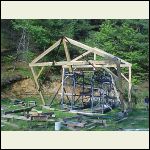
There are many ways. I wanted to keep untreated timbers out of the ground here. I poured 2' cubes with a formed neck above ground into which I had embedded a scrap steel plate with anchor bolts welded to the underside.
I then welded a spacing steel foot and made it hinge. When tipped up I welded the other sides to the embedded plate. My wife and I taking a break while winching it up. The old ways work. That is over a ton and about 25 feet tall and wide.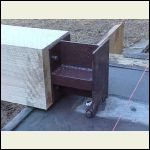
postfoot.jpg
| 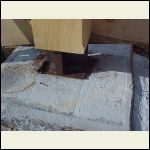
tipbase4.jpg
| 
bent2mid2.jpg
| |
|
|
TNwoodsman
Member
|
# Posted: 8 Jan 2026 10:55pm
Reply
Thats awesome to see. Those look like stout timbers.
My framing was going to be as follows, which I have a feeling will lead back to the ridgebeam:
I was going to use 2x6 for framing. 9 foot actual height of 2x6 (plus 4.5" from the bottom plate and two top plates. I was then going to set the loft floor joists at 7'6" using jack studs at each end. The jack studs would attach to the 2x6 studs.
I suspect this is not congruent to the triangle.
|
|
| << . 1 . 2 . 3 . >> |

